The best HWID spoofer explained step by step so you can get back into Fortnite, Valorant and Rust after a hardware ban
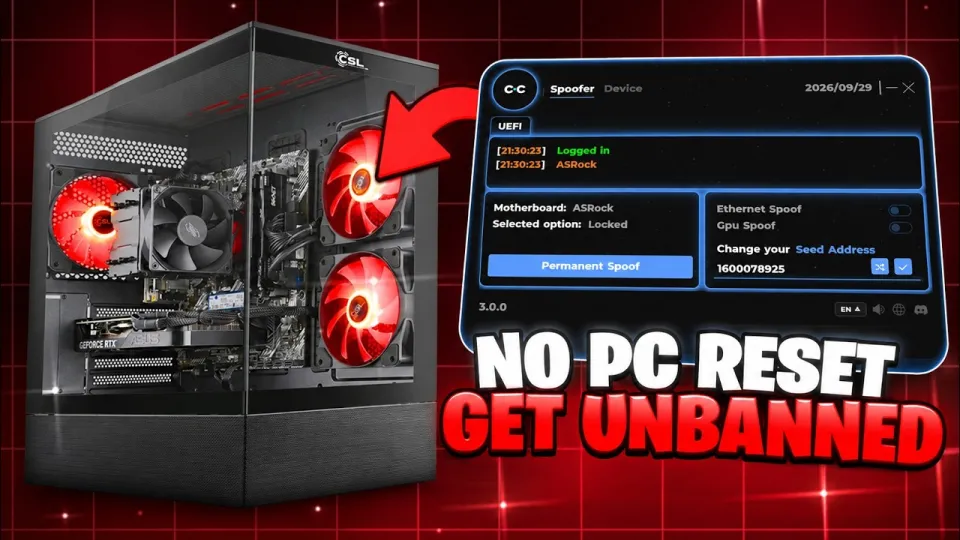
Video: The Ultimate HWID Spoofer Tutorial 2026 – Full Guide To Get Unbanned Fast
· based on the channel clixx
The best HWID spoofer is a tool that changes the hardware identifiers an anti-cheat reads from your PC, so a machine-level ban no longer points at your system. In the clixx tutorial the software is distributed through the CethCheats store and product page, where you can pick up the build, join the Discord, and use coupon code DENYS for 5% off. The guide below covers what the tool actually changes, how its interface and settings are laid out, how installation works, and which games it lists support for.
What an HWID spoofer actually changes on your PC
A hardware ID ban does not live on your game account; it lives on the fingerprint your machine sends to the anti-cheat. Spoofers rewrite that fingerprint so the server sees a different computer. The values that matter most are the ones that survive a Windows reinstall: the drive serial number, the SMBIOS and motherboard strings, the volume ID of your system partition, the MAC address of your network adapter, and the registry keys that store the machine GUID. A full spoofer touches all of them in one pass; a cheap one often changes only the disk serial, which is why bans come back within hours.
The clixx breakdown presents the software as a single panel that handles these system-level values rather than a per-game patch. That distinction matters: a Valorant HWID ban and a Rust HWID ban are enforced by different anti-cheat clients, but both read the same underlying hardware strings, so one clean spoof can cover several titles at once.
Inside the interface and the configuration options
The software is organised as a control panel with system tools on one side and configuration settings on the other. The overview section of the video shows the main window, the current hardware values it has detected, and the buttons that generate new ones. The configuration area is where you choose which identifiers get replaced and which are left alone — useful if you want a temporary HWID spoofer run for a single session rather than a permanent change.
Practical points to check in the settings before you run anything:
- Confirm every category is ticked — disk, SMBIOS, MAC, volume ID and registry — rather than just the drive serial.
- Note whether the tool offers a restore or backup option so you can return to your original values.
- Check the log or status window after applying, since a failed write to one identifier is easy to miss.
- Close the game and its launcher first; anti-cheat drivers can hold handles on the values being changed.
How the installation process works
The installation stage in the tutorial is short, and that is normal for this class of tool: download the archive from the store, extract it, and run the executable with administrator rights so it can write to protected registry and firmware-adjacent locations. The video's chapter list puts installation after configuration, which reflects the intended order — set your options first, then apply.
A few conditions decide whether the install goes smoothly:
- Disable real-time scanning or add an exclusion for the folder; spoofers are routinely flagged as riskware because of what they modify.
- Reboot after the first run so the new SMBIOS and disk values are read at startup.
- Verify the change with a system-info tool before launching a game, not after.
- Keep the original download, since a second run is often needed after a Windows update resets some identifiers.
Supported games and compatibility
The tool's listing covers Fortnite, Warzone, Rust, CS2, Rainbow Six Siege, Apex Legends and Valorant, plus FiveM servers for GTA roleplay. Those are the titles where hardware bans are most common and where a spoofer Fortnite or spoofer Valorant search usually leads. Compatibility is not only about the game: it is about the anti-cheat. Easy Anti-Cheat, BattlEye, Ricochet and Vanguard each read different combinations of identifiers, and Vanguard in particular is aggressive about detecting the drivers spoofers use.
That is why the same build can work cleanly for a Rust HWID spoofer use case and fail on Valorant. Before buying anything, match the tool to the specific anti-cheat you were banned under, and check whether the store lists that title explicitly rather than assuming "all games" means yours.
What to verify before you trust a spoofer
Testing is the part most tutorials skip, and it is where a permanent HWID spoofer earns or loses its price. After applying, open a hardware info utility and compare the disk serial, system UUID and MAC address against the values you had before. If two of the three are unchanged, the run failed. Performance is the second check: a well-built tool writes the values once and exits, while a poorly built one leaves a background service running that can cost frames or trip anti-cheat heuristics.
Usability matters too. A tool that needs a manual registry edit for every identifier is not worth the time when a panel with checkboxes does the same job. The clixx review frames the software around that convenience — one interface, one apply button, a log to confirm the result.
Links from the video
- Store and product page: https://cethcheats.cc/
- Discord community: https://discord.gg/ceth
- Discount: coupon code DENYS for 5% off
Final take on the best HWID spoofer workflow
Spoofing changes your hardware fingerprint; it does not restore a banned account, and the tutorial is clear that the goal is getting the machine back into a playable state. The workflow that holds up is boring: read the settings, apply every identifier category, reboot, verify with a system tool, then launch the game. The clixx breakdown is a useful walkthrough of that sequence because it shows the interface, the configuration screen and the install in one pass rather than promising a magic unban. If you want to try the build shown, start at the CethCheats store and remember the DENYS coupon.
Key takeaways
- An HWID spoofer replaces the hardware identifiers (disk serials, SMBIOS, MAC address, volume IDs) that anti-cheat systems use to link a banned account to a machine.
- The tool covered in the clixx breakdown is distributed through cethcheats.cc and its Discord, with a 5% coupon code DENYS.
- Supported titles listed for the software: Fortnite, Warzone, Rust, CS2, Rainbow Six Siege, Apex Legends and Valorant.
- The video walks through four stages: overview, features, configuration and settings, then installation.
- Spoofing is not the same as unbanning an account; it only changes the hardware fingerprint the anti-cheat reads.
Source: The Ultimate HWID Spoofer Tutorial 2026 – Full Guide To Get Unbanned Fast · Markdown version
Questions & answers
Does an HWID spoofer actually unban my game account?
No. A spoofer changes the hardware identifiers your PC reports, so a machine-level ban stops matching your system. The banned account itself stays banned; you would need a new account, and spoofing only prevents the new one from being flagged immediately by hardware association.
Is a free HWID spoofer safer than a paid one?
Free tools are usually the riskier option because they often modify only one identifier, such as the disk serial, and bans return quickly. They are also a common delivery method for malware. A paid build that covers SMBIOS, MAC, volume ID and registry values in one pass is more likely to hold up, though no spoofer is risk-free.
Which games does the spoofer in this tutorial support?
The listing covers Fortnite, Warzone, Rust, CS2, Rainbow Six Siege, Apex Legends and Valorant, plus FiveM. Compatibility depends on the anti-cheat rather than the game, so check that your specific title and its anti-cheat are named before you buy.
How long does an HWID spoof last?
A permanent spoof holds until something resets the identifiers — typically a major Windows update, a driver reinstall or a disk change. Temporary modes last for a single session and revert on reboot. Verify the values with a system-info tool after any update before launching a game.